
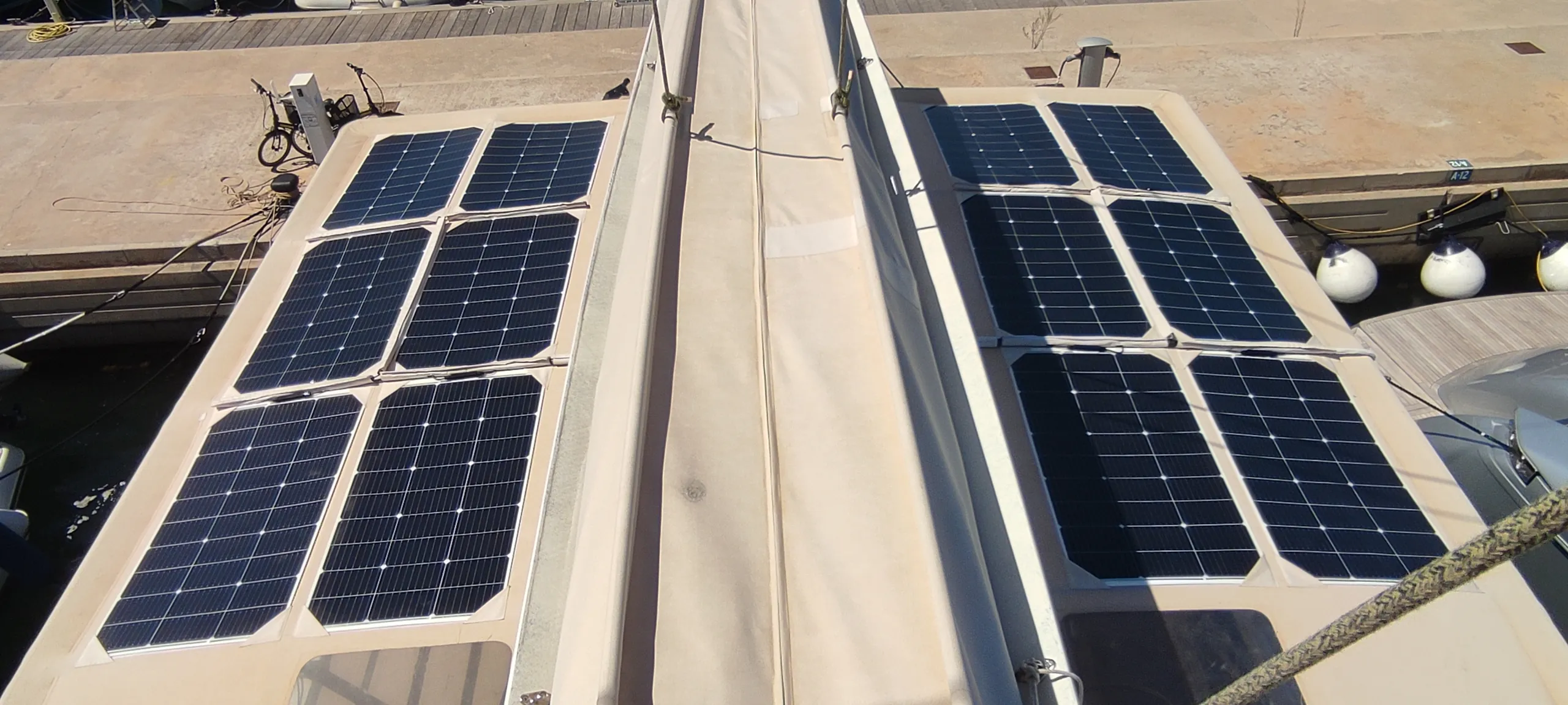
Lithium Batteries and Solar Panels for Yachts and Motorboats
Time to replace your house batteries again? For a comparable budget we will switch your boat to lithium iron phosphate (LiFePO4) batteries and add solar panels and monitoring — you can check the charge on your phone even when you are far from the boat. We work at your berth.
Sailing and motor yachts, motorboats and catamarans — from small leisure boats to large yachts. 12, 24 and 48 V systems.
Sound familiar?
- Your lead-acid or AGM batteries need replacing every 2–4 years.
- The label says 200 Ah, yet by evening at anchor the fridge and instruments have drained the bank — you can only use about half the capacity without damaging it.
- To recharge, you have to run the engine or head into a marina for shore power.
- Batteries left partly discharged over the winter have lost capacity by spring.
What switching to LiFePO4 gives you
| Lead-acid / AGM | LiFePO4 | |
|---|---|---|
| Usable capacity | about 50% of rated | 80–90% of rated |
| Service life | hundreds of cycles, typically 2–4 years on a boat | thousands of cycles |
| Weight | — | up to 70% lighter |
| Charging speed | slows down above ~80% | fast almost to full charge |
| Round-trip efficiency | about 80% | about 92% |
| Storage at partial charge | harmful (sulphation) | no harm |
Bottom line: the upgrade costs about the same as another set of lead-acid batteries but lasts several times longer — see the example from our work below.
From our work: a 60 ft catamaran
The boat had 8 × 12 V 215 Ah AGM batteries wired as 4 banks of 24 V. On average they lasted less than two years; a new set cost about €6,000 and weighed 560 kg.
We installed 3 Victron Energy 24 V 200 Ah lithium batteries with a BMS and a Cerbo GX control centre with a touch display, connected the chargers, engine alternators and solar panels to it, and set up remote monitoring and control. The equipment cost about the same €6,000.
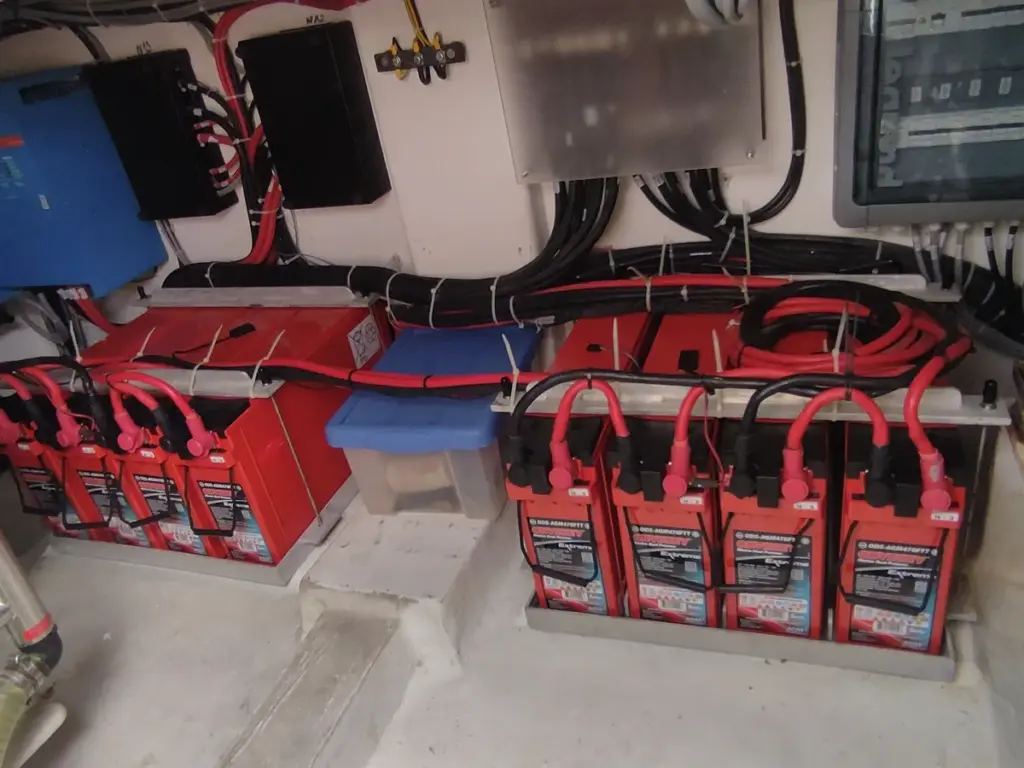
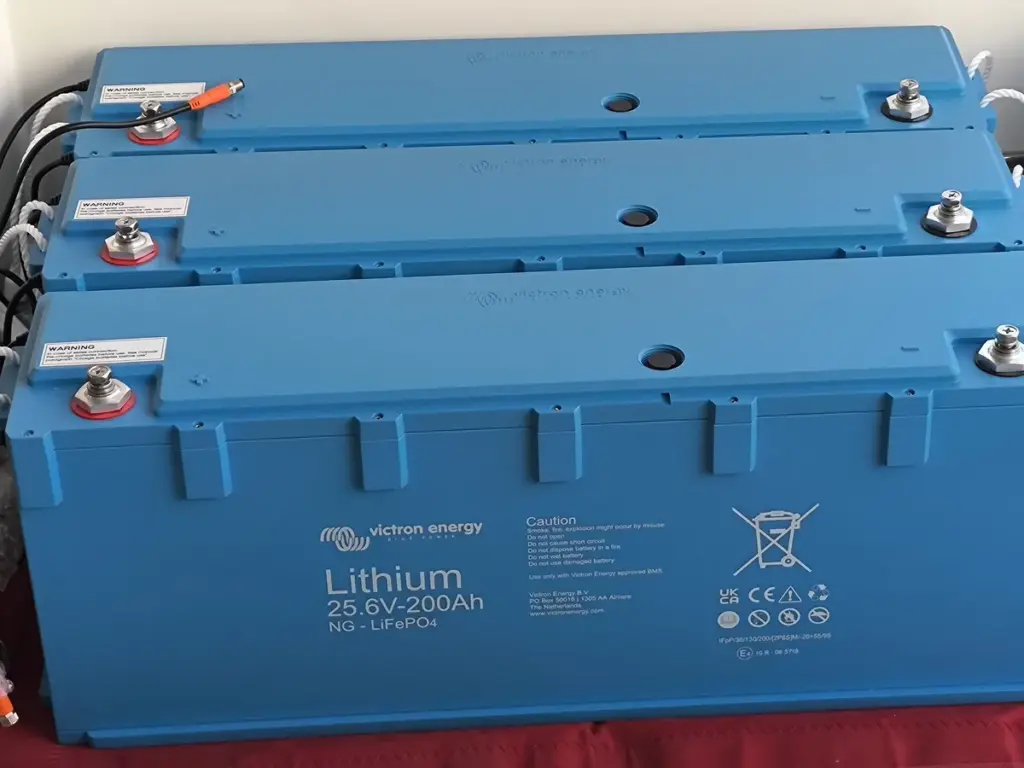
| Before: 8 × AGM 12 V 215 Ah | After: 3 × LiFePO4 24 V 200 Ah | |
|---|---|---|
| Rated energy | 20.6 kWh | 15.4 kWh |
| Usable energy | ≈ 10.3 kWh (50% discharge) | ≈ 12.3 kWh (80%) — ≈ 13.8 kWh (90%) |
| Weight | 560 kg | 111 kg (−449 kg) |
| Service life | less than 2 years | 2,500 cycles at 80% discharge |
| Round-trip efficiency | about 80% | 92% |
| Cost | ≈ €6,000 per set | ≈ €6,000 for the system |
Result: 20–35% more usable energy, almost 450 kg less weight, and the owner no longer buys new batteries every two years. Over 10 years that is 5 sets of AGM — about €30,000 — against one system.
What we do
Energy audit
We calculate the consumption on board (fridge, instruments, lights, pumps, inverter) and size the capacity, charging and panels to the way you use the boat.
Lithium house batteries
LiFePO4 with a battery management system (BMS), built-in or external; we replace lead-acid without rebuilding the compartment wherever possible.
Charging from the engine
A DC-DC charger or an external alternator regulator limits the current, protects the engine alternator from overheating and charges lithium correctly.
Solar panels
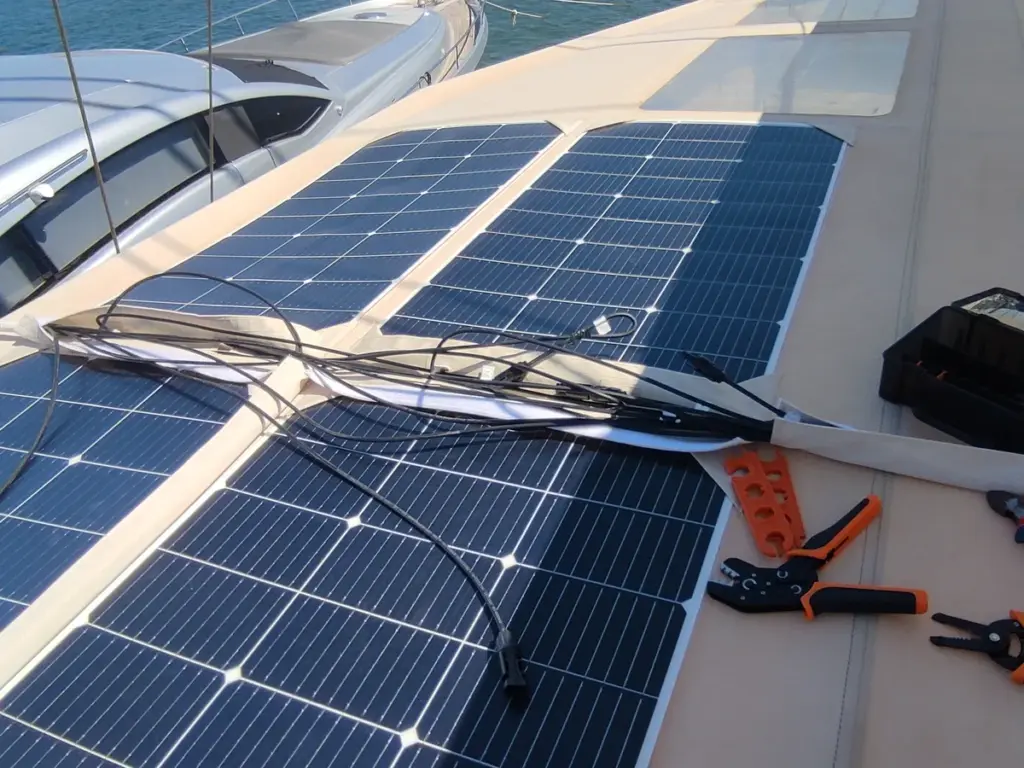
Rigid or flexible panels on the bimini, arch or deck with an MPPT controller. The boat charges itself, including at a berth without shore power.
Shore charger and inverter
We set up or replace the charger for a LiFePO4 profile and fit a 230 V inverter or inverter/charger.
Wind generators
One more charging source — at anchor and at night, when there is no sun.
Monitoring and automation
Exact state of charge in %, time remaining, history; remote access and alerts — see below.
Equipment: we work with Victron Energy and with more affordable manufacturers of equal quality, chosen to suit the job and the budget.
Monitoring: on board and remote
On board
- Battery shunt monitor: exact state of charge in %, current and time remaining — on a display or in a Bluetooth app.
- Data shown on your chartplotter via NMEA 2000.
- A control centre with a touch display — the whole power system on one screen.
Remote
- Via marina Wi-Fi or a 4G router on board: battery charge, solar yield and shore power voltage in an app on your phone, wherever you are.
- Alerts: low charge, shore power lost, alarm triggered.
- Automation: load shedding at low charge, switching consumers on and off remotely (for example the fridge before you arrive), automatic generator start.
- Sensors: bilge water, temperature, tank levels, security — with an alarm on your phone.
What else can be added to such a system
- A 230 V inverter/charger: coffee machine, hair dryer and power tools without a generator; automatic switch-over to shore power.
- Extra solar panels on the bimini and arch, a wind generator.
- A 4G router on board — monitoring keeps working outside the marina.
- Tank level sensors (fuel, fresh water, holding tank).
- Bilge water and temperature sensors with an alarm on your phone.
- GPS tracking and an alarm if the boat moves from its mooring.
Safety — it is not just “swapping a battery”
- A lithium battery needs correct charging: we set every source (engine, shore, solar) to the LiFePO4 profile.
- We protect the engine alternator with a DC-DC charger or an external regulator: without a current limit it can overheat, and when the BMS protection trips it can take a voltage spike.
- We fit fuses rated for the high short-circuit currents of lithium batteries.
- We take into account that LiFePO4 must not be charged in the cold: for most batteries below 0…+5 °C. This matters when the boat is laid up for winter.
Warranty on the work and the equipment; the term depends on the chosen equipment and the scope of the installation.
How we work
Discussion
Boat model, marina, your current batteries and what you power on board, photos of the battery compartment and switch panel.
Inspection
If needed, we come to the boat to inspect it.
Estimate
We draw up an equipment list and an estimate.
Date
We agree on a start date. The time needed depends on parts availability and the complexity of the installation.
Installation
We come and do the job: fitting, charging and monitoring set-up, a walk-through of the app, a photo report. We take the old batteries away for recycling.
Prices
Price on request.
The cost depends on the boat, its consumption and the chosen equipment — after a discussion or an inspection we prepare an estimate for equipment and labour.
Prices exclude VAT. We issue VAT invoices.
Where we work
Burgas, Sozopol, Nessebar, Varna and the whole Bulgarian coast; Northern Greece (Kavala, Nea Peramos, Halkidiki); Romania (Constanța, Mangalia). Trips abroad are planned in advance.
Frequently asked questions
What boats do you work on?
Sailing and motor yachts, motorboats and catamarans — from small leisure boats to large yachts. 12, 24 and 48 V systems.
Why LiFePO4 and not other lithium batteries?
Lithium iron phosphate is one of the most thermally stable lithium chemistries and the standard for boats and campers.
Can I simply put a lithium battery in place of the old one?
Physically, often yes — but without adjusting the charging and protecting the alternator the battery will be undercharged or fail early. That is why we start by checking the whole system.
Will solar panels be enough so I don’t have to run the engine?
It depends on your consumption and the space for panels. In the audit we calculate the balance and tell you honestly how many days of autonomy you will get.
Do I need internet for remote monitoring?
Yes: marina Wi-Fi or a 4G router on board. Monitoring on the boat itself works without internet.
What do you do with the old batteries?
We take them away and hand them in for recycling.
How long does the installation take?
It depends on parts availability and the complexity of the system. We agree on the start date after the estimate.
How do I winter the boat with lithium batteries?
For a long lay-up leave them at about 50% charge and disconnect the loads. Charging in the cold is blocked — we set this up during installation.
Other services
Hull blasting & antifouling removal
We strip old antifouling and primer with low-pressure wet blasting, at your marina.
Yacht service & repair
Engine, electrics, plumbing, gelcoat, osmosis, commissioning and winterising: one contractor for the whole boat.
Facade cleaning
We remove graffiti and dirt from stone, brick, concrete and render, and gently clean monuments.
Time to replace your batteries?
Send us photos of the battery compartment and a list of what you power on board — we will work out lithium and solar for your boat.